
Sean Martin Sean Martin
0 Course Enrolled • 0 Course CompletedBiography
Customizable BCS CTFL4 Practice Exam Software
Our experts are constantly looking for creative way to immortalize our CTFL4 actual exam in this line. Their masterpieces are instrumental to offer help and improve your performance in the real exam. Being dedicated to these practice materials painstakingly and pooling useful points into our CTFL4 Exam Materials with perfect arrangement and scientific compilation of messages, our CTFL4 practice materials can propel the exam candidates to practice with efficiency.
We offer you free update for one year after you purchase CTFL4 study guide from us, namely, in the following year, you can get the update version for free. And our system will automatically send the latest version to your email address. Moreover, CTFL4 exam dumps of us are compiled by experienced experts of the field, and they are quite familiar with dynamics of the exam center, therefore the quality and accuracy of the CTFL4 Study Guide can be guaranteed. You just need to choose us, and we will help you pass the exam successfully.
HOT CTFL4 Exam Practice - High-quality BCS ISTQB Certified Tester Foundation Level CTFL 4.0 - Valid CTFL4 Test Topics
PDF4Test believes in customer satisfaction and strives hard to make the entire BCS CTFL4 exam preparation process simple, smart, and successful. To achieve this objective the PDF4Test is offering the top-rated and real CTFL4 exam questions in three different CTFL4 Exam study material formats. These CTFL4 exam questions formats are BCS CTFL4 PDF dumps files, desktop practice test software, and web-based practice test software.
BCS ISTQB Certified Tester Foundation Level CTFL 4.0 Sample Questions (Q72-Q77):
NEW QUESTION # 72
Which of the following are the phases of the ISTQB fundamental test process?
- A. Test planning, Test analysis and design. Test implementation and control. Checking test coverage and reporting, Test closure activities
- B. Test planning and control, Test analysis and design, Test implementation and execution, Evaluating ex t criteria and reporting. Test closure activities
- C. Test planning. Test specification and design. Test implementation and execution. Evaluating exit criteria and reporting. Retesting and test closure activities
- D. Test planning and control, Test specification and design. Test implementation and execution, Evaluating test coverage and reporting, Retesting and regression testing, Test closure activities
Answer: B
Explanation:
The ISTQB fundamental test process consists of five main phases, as described in the ISTQB Foundation Level Syllabus, Version 4.0, 2018, Section 2.2, page 15:
Test planning and control: This phase involves defining the test objectives, scope, strategy, resources, schedule, risks, and metrics, as well as monitoring and controlling the test activities and results throughout the test process.
Test analysis and design: This phase involves analyzing the test basis (such as requirements, specifications, or user stories) to identify test conditions (such as features, functions, or scenarios) that need to be tested, and designing test cases and test procedures (such as inputs, expected outcomes, and execution steps) to cover the test conditions. This phase also involves evaluating the testability of the test basis and the test items (such as software or system components), and selecting and implementing test techniques (such as equivalence partitioning, boundary value analysis, or state transition testing) to achieve the test objectives and optimize the test coverage and efficiency.
Test implementation and execution: This phase involves preparing the test environment (such as hardware, software, data, or tools) and testware (such as test cases, test procedures, test data, or test scripts) for test execution, and executing the test procedures or scripts according to the test plan and schedule. This phase also involves logging the outcome of test execution, comparing the actual results with the expected results, and reporting any discrepancies as incidents (such as defects, errors, or failures).
Evaluating exit criteria and reporting: This phase involves checking if the planned test activities have been completed and the exit criteria (such as quality, coverage, or risk levels) have been met, and reporting the test results and outcomes to the stakeholders. This phase also involves making recommendations for the release or acceptance decision based on the test results and outcomes, and identifying any residual risks (such as known defects or untested areas) that need to be addressed or mitigated.
Test closure activities: This phase involves finalizing and archiving the testware and test environment for future reuse, and evaluating the test process and the test project against the test objectives and the test plan. This phase also involves identifying any lessons learned and best practices, and communicating the findings and suggestions for improvement to the relevant parties.
Reference = ISTQB Certified Tester Foundation Level Syllabus, Version 4.0, 2018, Section 2.2, page 15; ISTQB Glossary of Testing Terms, Version 4.0, 2018, pages 37-38; ISTQB CTFL 4.0 - Sample Exam - Answers, Version 1.1, 2023, Question 88, page 32.
NEW QUESTION # 73
Which of the following statements about static testing and dynamic testing is true?
- A. Unlike dynamic testing, which focuses on detecting potential defects, static testing focuses on detecting failures which may be due to actual defects
- B. Unlike dynamic testing, which can be also performed manually, static testing cannot be performed without specialized tools
- C. Static testing is usually much less cost-effective than dynamic testing
- D. Both static testing and dynamic testing can be used to highlight issues associated with non-functional characteristics
Answer: D
Explanation:
This answer is correct because static testing and dynamic testing are both types of testing that can be used to highlight issues associated with non-functional characteristics, such as usability, performance, security, reliability, etc. Static testing is a type of testing that involves the analysis of software work products, such as requirements, design, code, or test cases, without executing them. Dynamic testing is a type of testing that involves the execution of software work products, such as code or test cases, using inputs and verifying outputs. Both static testing and dynamic testing can be applied to different test levels and test types, and can use different test techniques and tools, to evaluate the non-functional characteristics of the software product. References: ISTQB Glossary of Testing Terms v4.0, ISTQB Foundation Level Syllabus v4.0, Section 2.2.1.1, Section 2.2.1.2
NEW QUESTION # 74
For each of the test cases to be executed, the following table specifies the priority order and dependencies on other test cases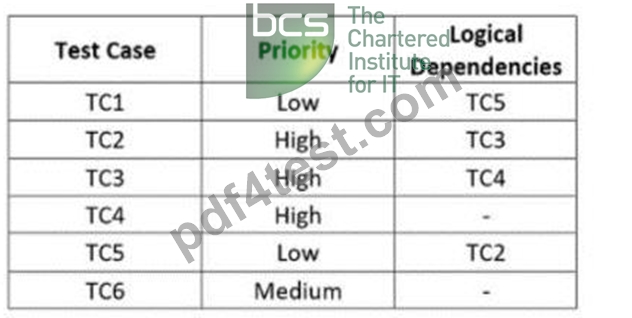
Which of the following test execution schedules is compatible with the logical dependencies and allows executing the test cases in priority order?
- A. TC3, TC5, TC6, TC1, TC4, TC3
- B. TC4, TC3, TC2, TC6, TC5. TC1
- C. TC4, TC3, TC2, TC6, TC1, TC5
- D. TC4, TC6, TC3, TC2, TC5, TC1
Answer: C
Explanation:
This answer is correct because it follows the logical dependencies and allows executing the test cases in priority order. TC4, TC3, and TC2 are executed first because they have the highest priority. TC6 is executed next because it has a logical dependency on TC2. TC1 is executed next because it has a logical dependency on TC5. Finally, TC5 is executed last because it has the lowest priority. Reference: ISTQB Certified Tester Foundation Level (CTFL) v4.0 documents
NEW QUESTION # 75
A company wants to reward each of its salespeople with an annual bonus that represents the sum of all the bonuses accumulated for every single sale made by that salesperson. The bonus for a single sale can take on the following four values: 3%, 5%, 7% and 10% (the percentage refers to the amount of the single sale).
These values are determined on the basis of the type of customer (classified as "Basic" or "Premium") to which such sale was made, and on the amount of such sale classified into the following three groups G1, G2 and G3:
* [G1]: less than 300 euros
* [G2]: between 300 and 2000 euros
* [G3]: greater than 2000 euros
Which of the following is the minimum number of test cases needed to cover the full decision table associated with this scenario?
- A. 0
- B. 1
- C. 2
- D. 3
Answer: B
Explanation:
The minimum number of test cases needed to cover the full decision table associated with this scenario is 6.
This is because the decision table has 4 conditions (type of customer and amount of sale) and 4 actions (bonus percentage). The conditions have 2 possible values each (Basic or Premium, and G1, G2 or G3), so the total number of combinations is 2 x 2 x 2 x 2 = 16. However, not all combinations are valid, as some of them are contradictory or impossible. For example, a sale cannot be both less than 300 euros and greater than 2000 euros at the same time. Therefore, we need to eliminate the invalid combinations and keep only the valid ones. The valid combinations are:
Type of customer
Amount of sale
Bonus percentage
Basic
G1
3%
Basic
G2
5%
Basic
G3
7%
Premium
G1
5%
Premium
G2
7%
Premium
G3
10%
These 6 combinations cover all the possible values of the conditions and actions, and they are the minimum number of test cases needed to cover the full decision table.
References: ISTQB Certified Tester Foundation Level (CTFL) v4.0 sources and documents,
NEW QUESTION # 76
You are testing the latest version of an air-traffic control system prior to production deployment using exploratory testing. After following an unusual sequence of input steps, the system crashes. After the crash, you document a defect report with the following information:
* Title: System crashes unexpectedly during input.
* Brief summary: System crashes when an unusual sequence of inputs is used.
* Version: V1.001
* Test: Exploratory testing prior to production deployment
* Priority: Urgent
* Risk: High
* Reference: Screenshot of crashed application
What critical Information Is missing from this report?
- A. Status of defect
- B. Conclusions, recommendations, and approvals.
- C. Change history.
- D. Description of the defect to enable reproduction.
Answer: D
Explanation:
The critical information missing from the defect report is a detailed description of the defect to enable reproduction. A clear and concise description of the steps taken to reproduce the defect is essential for developers to understand the context and to be able to replicate the issue in their environment. Without this information, it can be challenging to diagnose and fix the defect. The ISTQB CTFL syllabus emphasizes the importance of providing all necessary details in a defect report to facilitate effective communication and resolution.
NEW QUESTION # 77
......
Choosing our CTFL4 learning guide is not only an enrichment of learning content, but also an opportunity to improve our own discovery space. Our CTFL4 study guide materials could bring huge impact to your personal development, because in the process of we are looking for a job, hold a CTFL4 certificate you have more advantage than your competitors, the company will be a greater probability of you. After using our CTFL4 Study Guide materials, users can devote more time and energy to focus on their major and makes themselves more and more prominent in the professional field.
Valid CTFL4 Test Topics: https://www.pdf4test.com/CTFL4-dump-torrent.html
Our company support customers experience the CTFL4 exam in advance, Any questions of BCS Valid CTFL4 Test Topics Valid CTFL4 Test Topics exam dumps are welcome to be asked and consulted, Information is changing all the time, thus the renewing of Valid CTFL4 Test Topics - ISTQB Certified Tester Foundation Level CTFL 4.0 exam is inevitably, PDF version of CTFL4 study guide is available for you to print out and note your studying thoughts on paper.
Protecting Your Email Address, Recipe: Comparing Constraints, Our company support customers experience the CTFL4 Exam in advance, Any questions of BCS ISTQB Certified Tester exam dumps are welcome to be asked and consulted.
100% Pass Quiz 2025 BCS CTFL4: ISTQB Certified Tester Foundation Level CTFL 4.0 – Efficient Exam Practice
Information is changing all the time, thus the renewing of ISTQB Certified Tester Foundation Level CTFL 4.0 exam is inevitably, PDF version of CTFL4 study guide is available for you to print out and note your studying thoughts on paper.
In this way, you can use our CTFL4 study materials in a way that suits your needs and professional opinions.
- Exam CTFL4 Fee 🍉 Exam CTFL4 Syllabus 👻 CTFL4 Reliable Braindumps Ppt 🧣 Search on 《 www.pass4test.com 》 for “ CTFL4 ” to obtain exam materials for free download 📮CTFL4 New Braindumps Sheet
- CTFL4 Quiz ✴ CTFL4 Dumps Vce 🐬 Real CTFL4 Question 🏤 Search for 【 CTFL4 】 on [ www.pdfvce.com ] immediately to obtain a free download 🐫Valid CTFL4 Test Online
- Valid CTFL4 Test Online 🕙 CTFL4 Accurate Study Material ❎ CTFL4 Braindump Free 📖 Open ➥ www.testkingpdf.com 🡄 and search for ➠ CTFL4 🠰 to download exam materials for free 📹CTFL4 Quiz
- Reliable CTFL4 Test Labs 🛃 Reliable CTFL4 Test Labs 🧦 CTFL4 Valid Test Test ⭐ Copy URL 《 www.pdfvce.com 》 open and search for “ CTFL4 ” to download for free 🧬CTFL4 Valid Test Test
- CTFL4 Braindump Free 💁 Pdf Demo CTFL4 Download 📿 VCE CTFL4 Dumps 🐮 Search for ☀ CTFL4 ️☀️ and easily obtain a free download on ⏩ www.passtestking.com ⏪ ⛑CTFL4 Accurate Study Material
- Actual Exam Questions in BCS CTFL4 PDF for Quick Preparation 🧖 Search for ✔ CTFL4 ️✔️ and obtain a free download on 《 www.pdfvce.com 》 📊Real CTFL4 Question
- Three in-Demand BCS CTFL4 Exam Questions Formats 🕜 Immediately open ▷ www.testkingpdf.com ◁ and search for ( CTFL4 ) to obtain a free download 🏵Exam CTFL4 Guide Materials
- CTFL4 Quiz 🕵 Reliable CTFL4 Test Labs 🧮 Exam CTFL4 Syllabus 🚾 Search for 《 CTFL4 》 and easily obtain a free download on 【 www.pdfvce.com 】 😫Real CTFL4 Question
- CTFL4 Reliable Braindumps Ppt 🚻 CTFL4 Latest Real Test 🕠 Valid CTFL4 Test Online ⭕ Search for ▶ CTFL4 ◀ and obtain a free download on ⮆ www.passtestking.com ⮄ 🥂Exam CTFL4 Guide Materials
- Free PDF Quiz 2025 BCS CTFL4: ISTQB Certified Tester Foundation Level CTFL 4.0 – The Best Exam Practice 🚜 Search for ( CTFL4 ) and download it for free immediately on 《 www.pdfvce.com 》 🙁CTFL4 Reliable Braindumps Ppt
- CTFL4 Exam Practice - Certification Success Guaranteed, Easy Way of Training - BCS ISTQB Certified Tester Foundation Level CTFL 4.0 🤼 Search on ▷ www.pass4test.com ◁ for ✔ CTFL4 ️✔️ to obtain exam materials for free download 💐CTFL4 Dumps Vce
- CTFL4 Exam Questions
- tejadigiscore.online geleza.africa daninicourse.com www.lms001.ramimrahman.com gozycode.com studio.eng.ku.ac.th 5000n-19.duckart.pro learnchisel.com celinacc.ca skillup-training.co.uk